
Balancing work, family, and personal life has never felt more challenging for many in Bergen County, especially with the stress and uncertainty brought by the pandemic. You might be managing anxiety, relationship struggles, or the lingering effects of trauma while trying to keep up with daily responsibilities. Virtual counseling offers a flexible and private way to connect with a qualified therapist right from your own space. If you are ready for support that fits your real life, understanding how online therapy truly works and dispelling common myths is the first step.
Table of Contents
- Virtual Counseling Defined And Common Myths
- Core Benefits Of Online Therapy Sessions
- Popular Virtual Therapy Formats Explained
- Privacy, Licensing, And Safety Protections
- Challenges, Limitations, And How To Overcome Them
- Comparing Virtual And In-Person Counseling
Complete Virtual Counseling Guide: Myths, Benefits & Formats
| Point | Details |
|---|---|
| Virtual Counseling is Effective | Research shows virtual therapy produces similar outcomes as in-person therapy, particularly when the therapeutic relationship is strong. |
| Convenience and Accessibility | Online therapy offers flexibility in scheduling and location, making mental health services more accessible for individuals with time constraints or mobility challenges. |
| Privacy and Confidentiality | Virtual counseling adheres to the same privacy standards as in-person therapy, ensuring your personal information remains protected. |
| Multiple Formats Available | Various virtual therapy formats exist, including video, phone, eCBT, and messaging, allowing individuals to choose what best suits their needs and preferences. |
Virtual Counseling Defined and Common Myths
Virtual counseling, also called online therapy or teletherapy, is a professional therapeutic relationship conducted over the internet with a qualified mental health professional. Rather than sitting face-to-face in an office, you connect with your therapist through video conferencing, phone calls, email, or chat. The American Psychological Association and various licensing boards recognize virtual counseling as a legitimate form of mental health treatment when delivered by credentialed professionals who maintain the same ethical standards as in-person therapy. What makes this approach distinct is not the technology itself, but the fact that a licensed therapist provides actual clinical care through digital channels. Your therapist still conducts assessments, develops treatment plans, and provides evidence-based interventions, just through a screen instead of across a desk. For Bergen County residents working through stress, relationship issues, or pandemic-related trauma, this flexibility often means getting care at times and from locations that fit your actual life rather than forcing your schedule around an appointment location.
One major myth that circulates is thatvirtual counseling is less effective than traditional therapy. This simply isn’t supported by research. Studies show that video-based therapy produces outcomes comparable to in-person sessions across anxiety, depression, trauma, and relationship issues. The effectiveness depends far more on the quality of the therapeutic relationship and the specific treatment approach than whether a screen separates you from your therapist. Another persistent misconception is that online therapy compromises confidentiality. In reality, confidentiality concerns in virtual settings operate under the same legal frameworks as traditional therapy, though licensed professionals who offer teletherapy are required to use secure, encrypted platforms that meet federal privacy standards. Your therapist cannot share your information without your consent, just as they couldn’t in a physical office. Some people worry that technology will feel cold or impersonal, but many clients report that they actually open up more easily on video because the reduced intensity of in-person proximity can feel less intimidating. You’re sitting in a familiar environment, often your own home, which can create surprising comfort when discussing difficult topics.
A third misconception is that virtual counseling only works for certain issues or isn’t suitable for crises. While there are some appropriate limitations, qualified therapists trained in online delivery can effectively address trauma, depression, anxiety, couples counseling, and life transitions. Crisis situations do require clear protocols, and your therapist should establish crisis procedures during your first session. When exploring whether online therapy works for your specific situation, the key is finding a licensed professional experienced with teletherapy who specializes in your particular concerns. Some people also assume that virtual sessions cost less than in-person therapy, but pricing typically falls within the same range. What you gain is not necessarily a lower price tag but rather something more valuable: the ability to access quality care from your home in Bergen County without commuting time, flexible scheduling that accommodates work and family obligations, and the ability to maintain consistent therapy even when life circumstances change. The technology is simply the vehicle. What matters is that a qualified professional is helping you work through what’s actually troubling you.
Pro tip:During your first virtual session, test your technology at least 15 minutes early, sit in a quiet space with good lighting, and treat the digital session with the same respect you would a physical appointment by minimizing distractions and giving your therapist your full attention.
Core Benefits of Online Therapy Sessions
Online therapy removes one of the biggest barriers to mental health care: logistics. You no longer need to find a therapist within 20 minutes of your home, take time off work to sit in traffic, or rearrange your entire schedule around appointment hours. For Bergen County residents balancing jobs, family responsibilities, and personal commitments, this shift matters enormously. You can attend sessions from your home, your office during a lunch break, or even from a location that feels safer and more comfortable for discussing sensitive topics. Convenience transforms therapy from something you squeeze into your life to something that actually fits your life. This accessibility extends beyond just time and location. If you live in a more remote area or have mobility challenges, online therapy connects you with qualified professionals you might never have accessed otherwise. Research shows that online therapy modalities like cognitive behavioral therapy are efficacious for treating a variety of conditions including PTSD, substance use, and anxiety, which means you’re not sacrificing quality care for the sake of convenience.
Privacy and control represent another significant advantage that often gets underestimated. Many people feel more comfortable opening up from their own environment rather than in a therapist’s office. You control your physical space, which can reduce the intensity that some clients experience in a clinical setting. There’s no waiting room where you might run into someone you know, no receptionist hearing your name called out, no commute where you have to quickly shift back into your everyday persona. For those working through trauma, relationship issues, or deeply personal struggles, this layer of privacy can be genuinely liberating. You also have greater control over your session environment, whether that means having tissues nearby, sitting in a particular chair, or having a comfort item within reach. When exploring benefits of online therapy for your specific situation, consider how environmental control might help you engage more authentically with your therapist.
There’s also a continuity factor that often surprises people. If you move, travel for work, or experience a major life change, your therapy doesn’t have to stop. You maintain your relationship with your therapist regardless of geography. This consistency matters when you’re working through complex issues that benefit from long-term therapeutic relationships. Research indicates that online therapy enables continuity of care for clients, which is particularly valuable when you’re in the middle of processing trauma or developing new coping strategies. You’re not starting over with a new therapist every time circumstances change. Additionally, online therapy reduces logistical stress on therapists themselves, which means your therapist can focus more fully on your treatment rather than managing administrative burden. This creates better conditions for the work you’re both doing together. The flexibility also works both directions: if your therapist needs to reschedule, finding alternative times is often simpler when you’re not traveling to a physical location.
Pro tip:Create a dedicated space in your home for therapy sessions, even if it’s just a corner of a room with a closed door, and test your internet connection the day before your appointment to eliminate technical surprises that could interrupt your session.
Popular Virtual Therapy Formats Explained
Virtual therapy comes in several formats, each designed for different needs, preferences, and situations. Understanding what’s available helps you choose the approach that fits your life and your specific mental health concerns. The most common format is video therapy, where you connect face-to-face with your therapist through a secure video platform. This resembles traditional in-person therapy as closely as possible, allowing you to see your therapist’s facial expressions, body language, and nonverbal cues that contribute to the therapeutic relationship. Video sessions work well for most mental health concerns, from anxiety and depression to trauma processing and relationship counseling. The technology is straightforward: a computer, tablet, or smartphone with a camera and internet connection. For Bergen County residents, video therapy offers the visual connection of traditional therapy without the commute. Some people prefer phone-based therapy when video feels too exposing or when circumstances make video impractical. Phone sessions provide a vocal connection and the therapeutic relationship without the visual component. They work particularly well for people who feel more comfortable without being on camera, those with social anxiety, or individuals managing their therapy during busy workdays. The main limitation is that your therapist misses visual information, which can sometimes reduce the richness of communication, but many therapeutic approaches translate effectively to phone-only sessions.
Beyond video and phone, internet-based cognitive behavioral therapy (eCBT) represents a structured, often self-guided format that combines your own work with therapist support. You might complete online modules, worksheets, and exercises that target specific concerns like anxiety or depression, then check in with your therapist periodically to discuss progress and adjust your approach. This format appeals to people who prefer structure, want to work at their own pace, or need flexibility around scheduling. eCBT is particularly effective and cost-efficient for anxiety and depression, though it requires more self-motivation than traditional therapy where you show up and talk with someone guiding the process. Some platforms use text-based therapy or messaging, where you communicate with your therapist through secure messaging between sessions. This can be especially valuable during crisis moments or when you need to process something quickly without waiting for your next appointment. Messaging therapy creates a record of your thoughts you can review, which some people find helpful for tracking patterns. The tradeoff is that real-time support isn’t available, making this format less suitable for acute crises.
An emerging and innovative format is virtual reality (VR) therapy, which uses immersive simulations to help you practice skills or confront fears in controlled environments. For example, someone with a phobia of flying could experience an airplane cabin simulation with their therapist present, gradually building tolerance in a safe setting. VR therapy enhances engagement and treatment efficacy through experiential learning, allowing you to learn new responses to anxiety-provoking situations before facing them in real life. This format is still less widely available than traditional video therapy, but it’s growing in clinical practice. When considering which format suits you, think about your comfort level with technology, whether you need real-time interaction or can work more independently, and what specific issues you’re addressing. Multiple formats can complement each other too. Some people use different therapy types combined with virtual delivery to create a customized treatment plan. A skilled therapist can help you determine which format or combination of formats best supports your healing. What matters most is that the format feels accessible and sustainable for you, because the therapy that actually happens is the one you’ll stick with consistently.
Here is a comparison of popular virtual therapy formats and their typical best use cases:
| Format | Typical Best For | Visual Interaction | Client Effort Required |
|---|---|---|---|
| Video Therapy | Most mental health issues | Full visual cues | Moderate, attend scheduled |
| Phone-Based Therapy | Privacy, social anxiety | Audio only | Moderate, attend scheduled |
| Internet CBT (eCBT) | Anxiety or depression | Minimal or none | High, self-guided activities |
| Text/Messaging | Crisis moments, convenience | No real-time visuals | Low, write as needed |
| Virtual Reality (VR) | Phobias, experiential work | Immersive visual | High, technical setup needed |
Pro tip:If you’re unsure which virtual format works for you, try a video session first since it most closely mirrors traditional therapy, then discuss your comfort level with your therapist to explore alternatives if you feel you’d benefit from a different approach.
Privacy, Licensing, and Safety Protections
When you share deeply personal information with a therapist, you need absolute confidence that your privacy is protected. Virtual counseling operates under the same federal privacy laws as traditional therapy, with additional safeguards specifically designed for digital communication. The cornerstone is HIPAA (Health Insurance Portability and Accountability Act), which sets stringent standards for protecting patient privacy. Licensed therapists using virtual platforms must use secure, encrypted communications and secure data storage systems that prevent unauthorized access to your information. What this means practically is that your therapist’s video conferencing platform, messaging system, and file storage must meet federal encryption standards. Your therapist cannot share your information without your written consent except in specific legal situations, such as imminent danger to yourself or others. Beyond federal HIPAA requirements, many states enact additional privacy laws that promote transparency, restrict unauthorized use of patient information, and reinforce your rights over your data. This multi-layered approach means you have stronger protections than you might assume. Enforcement agencies like the Office for Civil Rights (OCR) and Federal Trade Commission (FTC) monitor compliance and investigate violations, providing consumer protection through both legal compliance and regulatory oversight. When choosing a virtual therapist or platform, ask specifically about their security measures. Reputable providers will clearly explain their encryption standards, data storage practices, and privacy policies without hesitation.
Licensing and professional credentials represent your second major protection. Licensed therapists in virtual settings must meet the same educational, training, and credentialing requirements as in-person therapists. However, state licensing laws create complexity for virtual counseling because therapists must typically be licensed in the state where you, the client, are physically located. For Bergen County residents, this means your therapist should be licensed in New Jersey. Some states participate in the Counseling Compact, which offers multi-state practice privileges to licensed counselors in participating states, streamlining cross-state practice. When you start virtual therapy, ask your therapist for their license information and verify it independently through your state’s licensing board website. You can look up their license number, confirm their credentials, and check whether any disciplinary actions exist. This verification takes five minutes and provides significant assurance. Your therapist should also carry professional liability insurance and maintain current training in ethical virtual practice. Reputable providers will have clear policies about their qualifications and welcome your verification questions. Red flags include therapists who refuse to provide license information, use vague credentials, or pressure you to start therapy immediately without proper intake procedures.
Informed consent and safety protocols create your third protection layer. Before beginning therapy, your therapist should provide clear written information about your rights, their credentials, how your data will be protected, the limits of confidentiality, and emergency procedures. This conversation matters because virtual therapy creates unique situations: what happens if your internet cuts out during a crisis? How will your therapist reach you if you miss an appointment? What is their backup communication plan? Ethical practice guidelines emphasize verifying your identity, ensuring informed consent, and maintaining confidentiality to uphold high safety standards in virtual counseling. Your therapist should confirm who they’re speaking with, especially relevant if someone else could access your phone or computer. They should also establish clear boundaries about what happens outside of scheduled sessions. Many virtual therapists have specific policies about text messaging, email communication, and emergency contact procedures. Ask about these during your initial consultation. A competent therapist will have thought through these scenarios and explain their safety approach. Your own safety practices matter too: use strong passwords, keep your therapy platform separate from casual social media if possible, and find a private space for sessions where others cannot overhear.
Pro tip:Before your first session, verify your therapist’s license on your state licensing board website, ask for a written privacy policy, and confirm their emergency protocols, then save this information in a safe place for future reference.
Challenges, Limitations, and How to Overcome Them
Virtual counseling offers genuine advantages, but pretending it has no drawbacks would do you a disservice. Real challenges exist, and understanding them helps you prepare and work around them effectively. Technical disruptions represent the most obvious hurdle. Internet drops, audio delays, frozen video, or connection issues can interrupt your session at critical moments. A therapist’s voice cutting out just as you’re discussing something vulnerable can feel jarring. These technological problems aren’t inherent failures of online therapy itself, but rather consequences of relying on internet infrastructure. The solution involves solid groundwork: both you and your therapist should use high-speed, reliable internet connections. Your therapist should have backup plans such as a secondary internet source or mobile hotspot. You should test your connection before sessions and position yourself close to your router. Choose a quiet space where others won’t disrupt your connection by using bandwidth-heavy devices. If technical issues do occur, a competent therapist will reschedule without penalty and continue your work in the next session. Some people also worry that reduced non-verbal communication limits connection. You see your therapist’s face and upper body, but you miss their posture shifts, hand gestures, and full spatial presence. This limitation is real. Certain therapeutic work, especially trauma processing or somatic therapy, relies heavily on observing the body. However, video therapy still captures the most important non-verbal elements: facial expressions, eye contact, tone of voice, and the overall quality of presence. Many clients report that they actually communicate more directly on video, speaking more clearly because they cannot rely on sitting quietly and being understood. Therapists trained in virtual delivery have adapted their clinical skills to work effectively within these constraints, using what’s visible on screen to deepen understanding.
Another genuine challenge is difficulty establishing therapeutic alliance in some cases. The therapeutic relationship is the foundation of effective therapy, and building that connection through a screen requires intentional effort from both you and your therapist. Some people naturally warm to video interaction while others find it awkward initially. The barrier is surmountable but not automatic. The way to overcome this is honest communication. Tell your therapist if you feel disconnected. A skilled therapist will adjust their approach, perhaps increasing check-ins about how you’re feeling about therapy itself, or shifting to a different format if video isn’t working. Crisis intervention presents a more significant limitation. If you experience a severe mental health emergency, virtual therapy has real constraints. Your therapist cannot physically restrain you, assess your immediate safety, or call emergency services with the same certainty as a therapist in the room with you. This is why establishing clear crisis protocols matters before an emergency occurs. Your therapist should discuss what to do if you experience suicidal thoughts, self-harm urges, or substance abuse episodes. Many virtual therapists have explicit boundaries stating they cannot serve as your only mental health provider if you are actively suicidal or in crisis. This is not a limitation of virtual therapy alone but a reflection of honest professional practice.

Privacy and confidentiality concerns deserve attention even though they are manageable. Therapy in your home means family members, roommates, or children could potentially overhear conversations. Your internet could theoretically be intercepted if you use public Wi-Fi. Your computer could be accessed by others. These are real risks, not myths. The solutions are straightforward: find a private, lockable space for sessions, use strong passwords on your devices, avoid public Wi-Fi during therapy, and inform people in your household about your therapy schedule and need for privacy. Your therapist should use encrypted platforms and secure storage. When both you and your therapist take basic precautions, your privacy in virtual therapy matches or exceeds that of traditional therapy where you drive to an office and sit in a waiting room. Standardized practice protocols and firm ethical guidelines, alongside therapist training in digital competencies, create the structure needed to address these challenges. The reality is that barriers exist, but competent, trained therapists have effective strategies to work within them. The technology itself isn’t the barrier, your awareness of potential issues and proactive problem-solving are what matter most. Virtual counseling works well when you choose a qualified provider who acknowledges limitations openly and has clear policies for handling them.
Pro tip:Before committing to long-term virtual therapy, schedule a consultation session to assess how the format feels for you, specifically noting your comfort with the technology, your connection quality, and whether you feel heard by your therapist, then discuss any concerns before starting regular sessions.
Comparing Virtual and In-Person Counseling
The question “which is better, virtual or in-person therapy” assumes one must be superior. The research tells a different story. A longitudinal study examining over 200,000 college students found that attendance rates and symptom improvements were comparable across virtual, in-person, and hybrid formats. This wasn’t a small sample or a single study. The data was collected over years and included diverse populations with varying mental health concerns. Clients showed equivalent effectiveness whether they attended therapy face-to-face in an office or logged in from home. This equivalence held true for depression, anxiety, trauma, and relationship issues. The key finding that researchers emphasize is that therapeutic relationship quality matters far more than the delivery method. Working alliance, which is the mutual trust and collaboration between you and your therapist, significantly predicts outcomes in both formats. A therapist who understands your concerns and you trust deeply will help you heal whether you’re sitting across from them or seeing them on screen. Conversely, a poor therapeutic match feels inadequate in person and feels inadequate online. Many clinicians and researchers now view virtual therapy not as a temporary substitute for in-person work but as a permanent complement to traditional treatment. Post-pandemic, many clients prefer a flexible hybrid approach, switching between formats based on their current needs and life circumstances.
So what are the actual differences? In-person therapy offers sensory richness and spatial presence. You sit in the therapist’s office, breathe the same air, experience their full body language, and benefit from the grounding presence of another human being in the room. For some people, especially those processing trauma or working with somatic approaches, this physical presence matters significantly. You cannot hug your therapist or receive other physical comfort, but the reality of their presence can feel containing and healing. In-person sessions eliminate technology barriers and create clear physical boundaries between your therapy space and everyday life. Walking into a therapist’s office signals to your brain that this is therapeutic time. Some people find this ritual psychologically important. However, in-person therapy requires commuting, scheduling around office hours, potentially taking time off work, and accepting whatever therapist is available in your geographic area. It also means potential waiting room encounters with other clients and less flexibility if your schedule changes. Virtual therapy removes logistical friction entirely. You gain flexibility, access to specialists regardless of location, and the ability to maintain therapy during life transitions. You sit in your own environment where you feel safe and comfortable. For some issues and some people, this reduces anxiety rather than increasing it. The therapeutic relationship builds effectively through video when both therapist and client are invested. However, you miss full spatial presence, rely on technology that can fail, and must create your own therapeutic boundary between sessions and daily life.
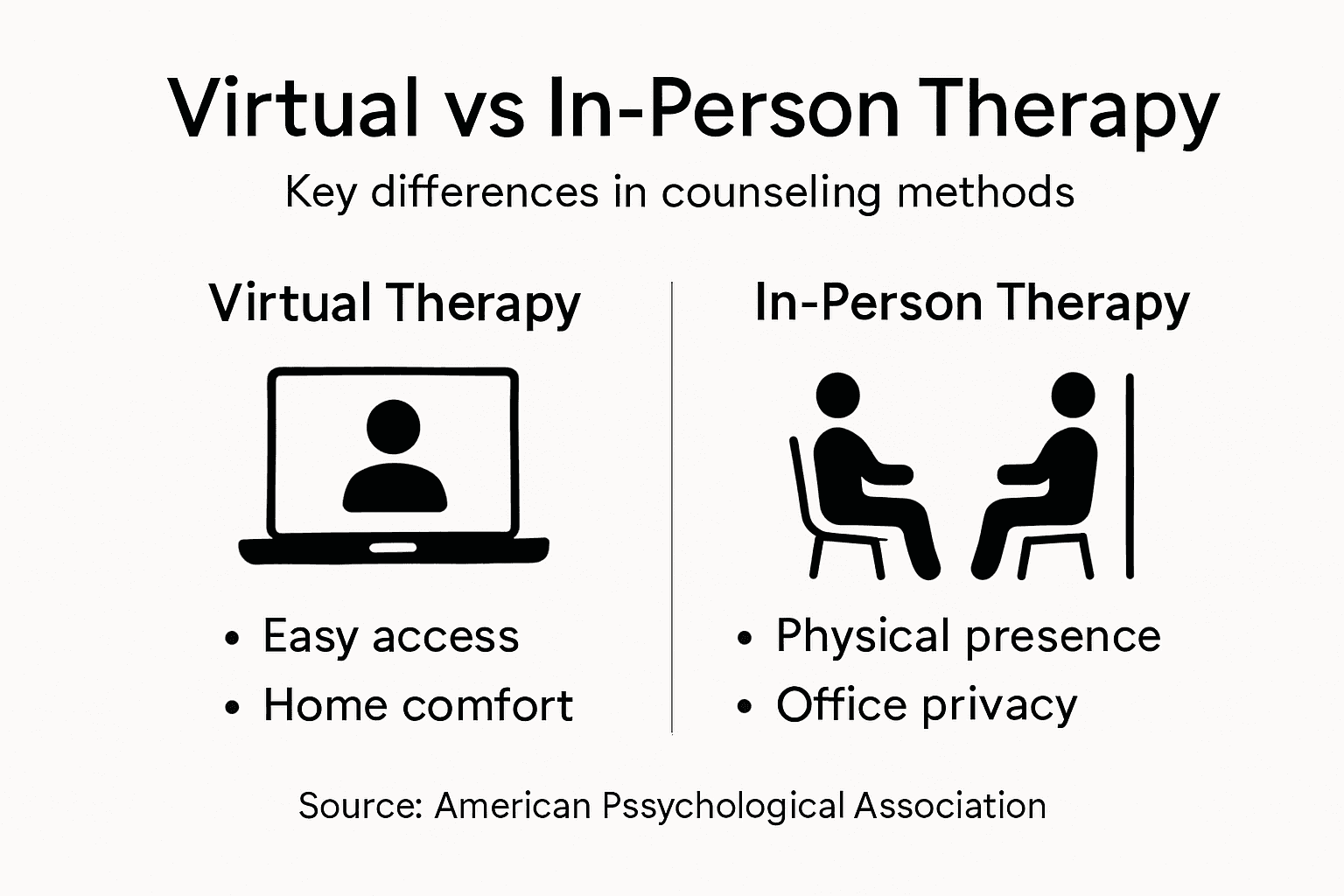
To help you decide between virtual and in-person therapy, consider these differences by experience factor:
| Experience Factor | Virtual Therapy | In-Person Therapy |
|---|---|---|
| Flexibility | Attend from any location at convenient times | Requires travel to specific location |
| Sensory Cues | Limited to facial expressions and voice | Full body language and environment |
| Privacy Management | Private at home, self-controlled environment | Office setting, clinician-managed privacy |
| Response to Tech Issues | May experience connection disruptions | No technology interruptions |
| Therapist Selection | Wider options beyond local area | May be limited to local professionals |
The practical reality for Bergen County residents is that the choice often comes down to individual preference, life circumstances, and what works for your specific mental health needs. Some therapists offer virtual couples therapy services, making online formats especially convenient for partners managing relationship issues together. Others specialize in modalities that work particularly well in person. A hybrid approach where you do some sessions virtually and some in-person gives you maximum flexibility. Your first session is genuinely the time to assess which format feels right for you. Pay attention to whether you feel heard, whether the therapist explains things clearly, and whether you feel comfortable sharing. Notice your own experience of the technology. Some people feel instantly at ease on video; others feel self-conscious. This subjective experience matters. The research confirms that effectiveness depends on the quality of your relationship with your therapist and whether their approach matches your needs, not whether a screen separates you. The best therapy format is the one you will actually attend consistently and engage fully in. If virtual therapy removes barriers that would otherwise prevent you from seeking help, it is unquestionably the better choice for you. If you find in-person therapy more grounding and healing, that is equally valid. The decision is personal, not one-size-fits-all.
Pro tip:If you are undecided between virtual and in-person therapy, start with one format for three sessions, then reflect on whether you felt heard, comfortable, and engaged before committing long-term or switching formats.
Embrace the Convenience and Comfort of Virtual Counseling Today
Modern life brings unique challenges balancing work, family, and personal well-being. If you’ve been wondering how to overcome barriers like scheduling conflicts or commuting stress while still accessing quality therapeutic care, virtual counseling offers a flexible and effective solution. This approach lets you connect with licensed therapists from the comfort of your own home, using secure digital platforms recognized for their privacy and safety. Whether you face anxiety, life transitions, or relationship struggles, telehealth Archives – Dr. Stephen Oreski & Associates provides resources and insights tailored for your journey.

Take control of your mental health by exploring personalized online therapy options with Dr. Stephen Oreski and his team.
Visit our website to schedule a free consultation and find the right therapist who understands your needs.
For support during your life changes, check out life transitions Archives – Dr. Stephen Oreski & Associates to learn how virtual therapy can keep pace with your evolving circumstances. Don’t wait to access compassionate care designed around your life. Start your path to lasting positive change now.
Frequently Asked Questions
What is virtual counseling?
Virtual counseling, also known as online therapy or teletherapy, is a professional therapeutic relationship conducted over the internet with a licensed mental health professional. It can take place through video conferencing, phone calls, emails, or chat.
Is virtual counseling as effective as in-person therapy?
Yes, research indicates that virtual counseling produces outcomes comparable to in-person therapy for various mental health issues, including anxiety, depression, and trauma. The effectiveness largely depends on the quality of the therapeutic relationship rather than the mode of delivery.
How does confidentiality work in virtual counseling?
Confidentiality in virtual counseling is upheld under the same legal frameworks as traditional therapy. Licensed professionals use secure, encrypted platforms to ensure that your information is protected, similar to in-person therapy.
Can virtual counseling help with crisis situations?
While virtual counseling can address many mental health issues effectively, specific protocols for crisis situations are necessary. Your therapist should discuss emergency procedures during your first session to ensure your safety in case of a crisis.