

If you’re dealing with PTSD, look for a licensed, trauma-trained clinician: a psychologist, LCSW, LPC, or LMFT who practices an evidence-based approach like CPT, PE, or EMDR, and a psychiatrist if medication becomes part of the plan. The next step is simple. Book an intake with someone trained in trauma-focused treatment, or call 988 right now if you’re in crisis.
TL;DR:
- Trauma-focused therapies like CPT, PE, and trauma-focused CBT typically require several sessions, with complex cases potentially needing longer treatment periods.
- Credentials matter more than licensure alone; therapists trained and certified in specific trauma protocols (CPT, PE, EMDR) under supervision provide the most effective care.
- During initial sessions, expect assessment and stabilization techniques before trauma processing, with a typical timeline of 1 to 3 sessions for evaluation and 6 to 16 for treatment.
- In crisis, immediate support is available through 988 or SAMHSA helpline, and urgent psychiatric evaluations should be sought through providers or emergency services.
- Choosing the right therapist involves verifying trauma-specific training, assessing personal fit, logistics, and asking targeted questions during a consultation to ensure shared understanding of treatment approach.
Table of Contents
- PTSD Therapist Bergen County NJ: Evidence-Based Treatments That Work
- Who Can Actually Treat PTSD? Credentials That Matter
- How to Choose a PTSD Therapist in Bergen County
- What Happens in Your First Sessions
- If You Need Help Right Now
- Why Fit and Repair Matter More Than People Realize
- Book a Free Consultation With Bergencountytherapist
- Sources
- FAQ
PTSD Therapist Bergen County NJ: Evidence-Based Treatments That Work
Three approaches carry the strongest research backing for PTSD, according to the VA’s National Center for PTSD: Cognitive Processing Therapy (CPT), Prolonged Exposure (PE), and trauma-focused Cognitive Behavioral Therapy (CBT). EMDR, or Eye Movement Desensitization and Reprocessing, is also highly supported and works differently from the other three.
CPT teaches you to identify and challenge the stuck beliefs trauma leaves behind, things like “it was my fault” or “I can’t trust anyone.” PE has you gradually approach trauma memories and avoided situations, in a structured, paced way, so the fear response loses its grip. Trauma-focused CBT blends both, pairing cognitive work with gradual exposure. EMDR uses bilateral stimulation, usually guided eye movements, while you focus on a trauma memory, and many clients find it processes material without requiring detailed verbal retelling.
Session counts vary by person, but the guidelines give you a rough map:
- CPT, PE, and trauma-focused CBT typically require several sessions.
- EMDR generally involves multiple sessions, often scheduled once or twice weekly.
- Complex or long-standing trauma can extend any of these timelines significantly.
Pro Tip: Ask your therapist upfront how many sessions their protocol usually takes and how they’ll know it’s working. A clinician following a real protocol should have a clear answer.
Medication sometimes enters the picture, particularly SSRIs like sertraline or paroxetine, though VA clinical guidance treats psychotherapy as the first-line option for most people, with medication as an adjunct rather than a substitute. The APA’s PTSD treatment guideline is explicit on this point: no single therapy fits everyone, and the right choice depends on shared decision-making between you and your provider, weighing the evidence against your own history, preferences, and comfort level.
Who Can Actually Treat PTSD? Credentials That Matter
Several types of licensed professionals can diagnose and treat PTSD, but their scopes differ. Psychologists (PhD or PsyD) provide psychotherapy and psychological testing. Psychiatrists (MD or DO) can prescribe medication and, in some practices, also provide therapy. Licensed Clinical Social Workers (LCSW), Licensed Professional Counselors (LPC), and Licensed Marriage and Family Therapists (LMFT) all provide psychotherapy but cannot prescribe medication.
The license alone doesn’t guarantee trauma competence. What matters more, according to the VA’s guidance on therapist types, is specific training in a manualized trauma protocol and supervised experience delivering it. When you’re vetting a provider, ask directly:
- Are they trained and certified in CPT, PE, or EMDR, not just generally “trauma-informed”?
- Have they treated PTSD under supervision before practicing independently?
- Do they take your insurance, or can they provide superbills for out-of-network reimbursement?
If you don’t know where to start, NIMH’s list of professional directories, including the Academy of Cognitive and Behavioral Therapies and the National Association of Social Workers, can help you locate licensed, trauma-trained clinicians near you.
How to Choose a PTSD Therapist in Bergen County
Choosing well comes down to matching credentials, logistics, and personal fit, in that order. Here’s a sequence that works:
- Confirm licensure and trauma training first. A license without specific PTSD protocol training (CPT, PE, EMDR) is not enough.
- Check modality fit against your situation. Someone with severe dissociation may need more stabilization work before diving into memory processing, particularly with EMDR.
- Verify logistics. In-person or online sessions, insurance acceptance, and realistic scheduling all affect whether you’ll actually stick with treatment.
- Use the free consultation to interview them, not just get interviewed. This is your chance to assess fit before committing.
During that consultation, ask pointed questions: “What’s your experience treating PTSD specifically?” “Which protocol do you use, and why?” “How do you handle dissociation if it comes up?” “What’s a realistic timeline for someone with my history?” A therapist following an actual evidence-based approach should answer these clearly and without hedging.
Watch for red flags. A provider who pushes rapid trauma processing in the first session, skips any kind of assessment, discourages your questions, or can’t explain the reasoning behind their approach is not practicing shared decision-making, and that’s a problem regardless of how warm they seem.
Pro Tip: Fit matters as much as modality. Research on psychotherapy outcomes shows that ruptures in the working relationship happen even with skilled therapists, so ask how they’d handle a moment where you felt misunderstood or frustrated. Their answer tells you a lot.
For readers navigating complex or repeated trauma, this vetting process matters even more, since longer treatment courses raise the stakes of a poor initial match.
What Happens in Your First Sessions
The first one to three sessions typically focus on assessment, not treatment. Your therapist should ask about symptom history, screen for medical conditions that mimic PTSD symptoms, assess any safety or suicidality concerns, and establish a baseline using a validated measure like the PTSD Checklist (PCL-5).

Before diving into trauma memories, many clinicians spend time on stabilization: grounding techniques, distress tolerance skills, and affect regulation strategies that give you tools to manage intense emotions when memory work begins. This isn’t stalling, it’s groundwork that makes the harder phase safer and more effective.
A typical arc looks like this:
- Assessment and stabilization: 1 to 3 sessions.
- Trauma-focused processing (CPT, PE, EMDR, or CBT): 6 to 16 sessions, depending on protocol and complexity.
- Review, consolidation, and relapse-prevention planning: 1 to 3 sessions.
Your therapist should periodically reassess using the same measures from intake, and adjust the plan, adding medication, extending sessions, or shifting modality if progress stalls. For between-session support, practical symptom management strategies can help you stay grounded while the deeper work unfolds.
If You Need Help Right Now
If you’re in crisis, don’t wait for an appointment. Call or text 988, the Suicide & Crisis Lifeline, available 24/7. The SAMHSA National Helpline at 1-800-662-4357 also operates around the clock, every day of the year, and can connect you to local treatment resources.
- Call or text 988 for immediate crisis support, day or night.
- Call SAMHSA at 1-800-662-4357 for treatment referrals and support.
- Text your ZIP code to 435748 (HELP4U) to find nearby help.
- If you’re in immediate danger, call 911 or go to the nearest emergency room.
For urgent (non-emergency) psychiatric evaluation, call a provider’s office directly and ask about same-week openings. Many practices hold slots specifically for new patients in acute distress.
Why Fit and Repair Matter More Than People Realize
Most people assume a good therapist never causes friction. That’s not how it works. Ruptures in the therapeutic relationship, moments of feeling unheard or misread, happen even in strong treatment. What separates effective care is how the therapist responds: through validation and genuine curiosity about what went wrong, rather than rushing to fix or defend. Research on alliance repair backs this up directly.
At Bergencountytherapist, that’s part of why personalized plans and flexible in-person or online delivery matter so much. Ask any provider, including ours, how they’d handle a moment of friction with you. The answer reveals more than any credential list.
— Stephen
Book a Free Consultation With Bergencountytherapist
Unlike a directory search that leaves you cold-calling strangers, Bergencountytherapist puts you directly in touch with a team led by Dr. Stephen Oreski that already practices the evidence-based approaches this article covers, CPT, PE, EMDR, and CBT, delivered in-person or online depending on what fits your life.

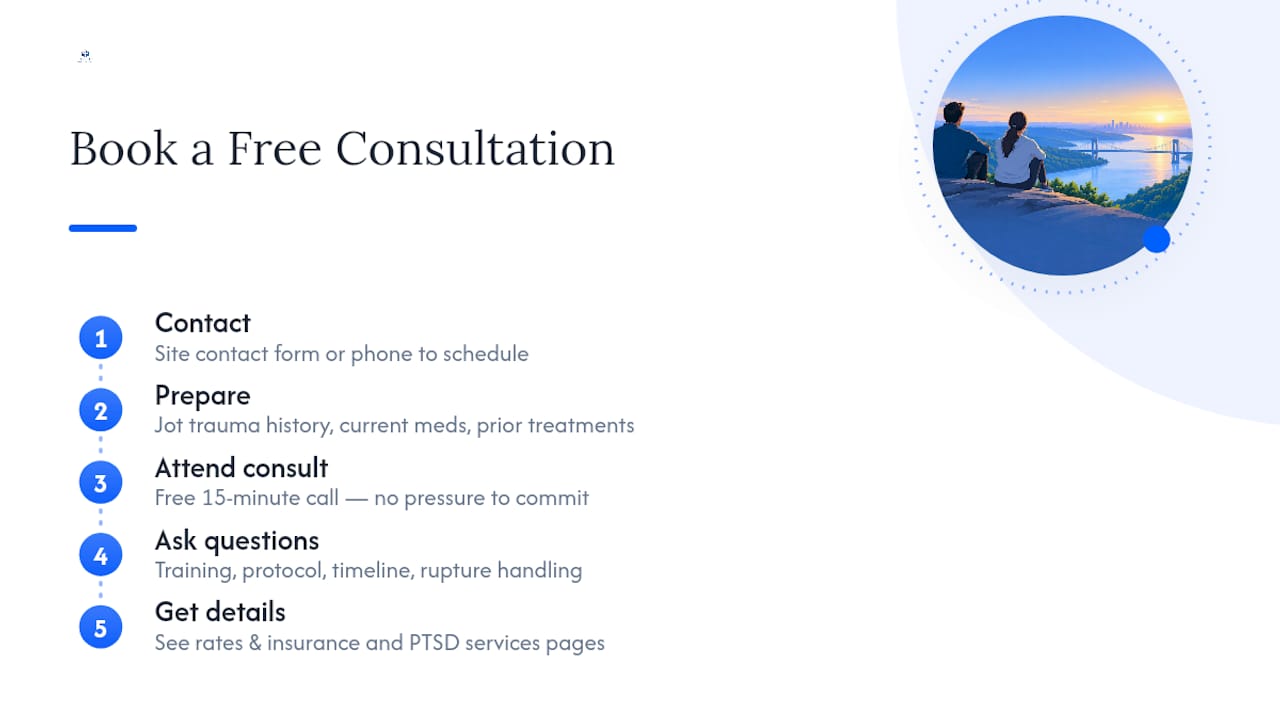
The free 15-minute consultation is where you ask the exact questions outlined above: training, protocol, timeline, how ruptures get handled. There’s no pressure to commit on that call. If you want details on coverage first, the rates and insurance page lays out what to expect, and the PTSD services page covers the specific modalities offered for adult trauma treatment.
Before your call, jot down a rough trauma history, any current medications, and what you’ve tried before, if anything. Reach out through the site’s contact form or phone line to get on the schedule. That one call is the actual next step, not another week of research.
This article is general information, not a substitute for advice from a qualified doctor. Consult a qualified healthcare professional about your own circumstances before acting on anything here.
Sources
- VA: Choosing a PTSD treatment that’s right for you
- SAMHSA: Find support in an emergency
- APA: Clinical Practice Guideline for the Treatment of PTSD in Adults
FAQ
What type of therapist should I see for PTSD?
Look for a licensed psychologist, LCSW, LPC, or LMFT trained specifically in CPT, PE, or EMDR, since general trauma awareness isn’t the same as protocol-specific training. A psychiatrist can be added to the team if medication like an SSRI becomes appropriate, per VA guidance.
Who should not do EMDR right away?
Clients with significant dissociation or very limited affect-regulation skills typically need stabilization work first, since EMDR’s memory-processing phase requires the ability to stay grounded. A qualified therapist assesses this before starting, not after problems emerge.
Where can I find PTSD support between therapy sessions?
Peer support groups and moderated forums exist, but they vary widely in quality and safety, so ask your therapist for a vetted recommendation rather than searching blindly. Crisis-level distress should go to 988 or SAMHSA’s helpline, not an unmoderated chat room.
What are signs my therapist might be frustrated with me?
Subtle signs include rushed sessions, less curiosity about your experience, or a shift toward generic advice instead of engagement with your specific history. Rather than guessing, ask directly how they handle moments of tension. Research on alliance rupture repair shows that naming the friction openly, and getting a validating response, tends to strengthen treatment rather than derail it.
Does Bergencountytherapist offer PTSD-specific treatment?
Yes. A qualified therapy practice may offer PTSD-focused treatment including EMDR and CBT-based approaches, available both in-person and online. Current rates aren’t listed publicly, but you can review coverage details on the rates and insurance page or start with a free consultation.
Recommended
- PTSD Therapy: Find Healing in Paramus, NJ
- Strategies for Managing PTSD Symptoms – Dr. Stephen Oreski & Associates
- Recover from PTSD with VA/DoD Evidence Based Roadmap, Bergen County & Online
- EMDR Therapy for Trauma & PTSD in Bergen County, NJ: Evidence-Based Healing – Dr. Stephen Oreski & Associates